agile, scrum, team leading, coaching, training, project management
Showing posts with label digital reflections. Show all posts
Tuesday, 30 July 2019
Tactics for maintaining quality under pressure
Yesterday, I had great time joining some of my friends at Endava and their guests for the presentation of “Tactics for maintaining quality under pressure” by Eoin Woods (CTO at Endava).
Liked Eion’s straightforward style and fast-speed-talk. The presented tactics are somewhat common-sense, and at the same time critical for successful delivery, so I decided to drop my 2 cents on each of those.
1. Understand the context
Context is the king... I would stress on understanding the business value and the underlying business needs and pain-points behind the technical requirements. Those needs could probably be satisfied in innovative and creative way, and in order to inspire those we need to present to the techies why do we have such requirements and what in the end we try to achieve ...and again: WHY?
2. Make implications clear
Any workarounds and cutting-edges approach costs should be clearly communicated. If in the future we need to refactor or even redesign and redevelop entirely services just because of today’s decisions – those should be clearly explained and agreed on with the product folks on client’s side. Those are even worse if the consequences are on architecture’s side.
3. Track and cost technical debt
Another great tactic… with my teams we regularly follow. Putting the technical debt as backlog items and roughly estimating them helps us backing up decisions to force any of the most critical items, prioritized and tackled in future iterations.
4. Make quality visible
Another important one. I would say even critical for iteration review. Visibility over functional and performance tests increases trust and shows everybody that quality matters!
5. Simplify
Simplicity is a favorite principle of mine. Less complexity often leads to better quality and maintainability.
6. Automate everything
Another obvious one; I would only disagree that it depends on the project size and context. Sometimes the overhead could be too much, trying to automate everything possible. Also, we should not forget automation requires maintenance too. Do we want to spend a lot of our team’s time and effort in maintaining automation? Balance is the key.
7. Enforce valuable process, discard the rest
Processes, just for the sake of doing them, should be discarded. Nevertheless, I work mostly on creating and inspiring the healthy culture of delivery, respect and learning within everybody in the company. As we all are aware – 'healthy culture will handle broken processes'. Yes, it is more difficult and time-consuming to influence and change the company's culture, but in the end it’s more beneficial for everyone too.
--
Kudos to Eion for inspiring my thoughts on the topic.
Friday, 16 June 2017
Business storytelling
'The most powerful person in the world is the storyteller.'
- Steve Jobs
Hi guys, it was great to attend a storytelling workshop (@EvgeniMitev) and would be sharing my
notes below:
I. Basic rules and structure
- Should have mystery and unexpected ending.
- Hunger for dramatic event, conflict and twist.
- Share some wisdom in the end.
'Our personal stories are subject to plotting laws.'
II. High view
- Convey knowledge, info and values through story.
- Need to inspire on all levels.
- Not everything could be communicated by images .
- The resource of time is more valuable nowadays - to hold attention.
Ask yourself:
- Why do I want to communicate something?
- What do I want to communicate?
- How do I want to communicate it?
When you read something, you read it with your own tone of
voice.
Attitude:
- I'm eager to tell you
- You won't believe what happened to me
- I would not tell everybody (create trust)
---
Good exercise is
the elevator pitch: spark interest in under 30 secs.
Mission, vision, values have to be communicated properly.
Get feedback and learn from mistakes/difficulties.
'Facts and numbers do talk ... but facts and numbers can't inspire people.'
Don't just show the numbers! Tell the story. Data need
context and story, imagination and soul.
Storytelling activates both left and right hemispheres of
the brain.
III. Forms
- Insights.
- Open-ended stories.
- Serious games - to be used in business environment (online or offline).
- Could be a case study, and challenge the participants.
- Personal stories with key emotion.
- Jokes. The humor introduces surprise - that's why the brain react good on it.
---
The idea of the story is to create cycle:
'Inform - inspire - provoke action - get feedback - provoke
change/transformation'
IV. Tools
Canvas and basic structure:
---
Star Wars is amazing example of good storytelling. The
structure is:
- Show the worst moments, what happened and how bad it was. It brings the power of context.
- From bad to worse paradigm. Has to be really well described.
- Action - conflict, struggle, pain.
- Resolution - good or bad ending.
RISK is what is important.
'Each action in risk creates value'
- Stories could end without resolution, just getting worse and finish.
- Many authors use structured approach - practicality and results.
- Reframing is a good technique to be used with difficult situations.
- Deframing, also used: zoom in - zoom out.
- Creating context is very important - may use story cube dice to create context.
V. Skills
- Ask good questions.
- Listen carefully in order to tell good stories.
- Simplicity and clarity in storytelling.
- Empathy (it's all about emotions).
- Know your weaknesses and use them them to puzzle yourself and the audience.
VII. Guidelines
- Write down interesting stuff happening around you (also jokes, strange situations).
- Have to notice and be radically honest.
- Simplicity - make your stories simple to comprehend.
- Talk about and convey your values.
- Aim for greatness. Teach yourself the difference between good and great.
- Be vulnerable and honest. Share mistakes, fails, challenges.
- Research your inside monologue. What does it, what is the tone, who of you inner characters talks at different moments.
- Change the story you tell to yourself.
- Share the turning moments in your life.
- Write down the wisdom out of them and reformulate all useful actions.
- Gather images which touch you. (they show your authenticity - what is important for you)
- Research an image bank to investigate how the 'searching, labeling and tagging' works.
Friday, 28 October 2016
Yulian Tonkin - personal development untour (24, 25 OCT)
“You either grow, or die”
It was cool. The stuff to share/remember/do…
Day 1: self-development
- Use your body to study better. Use your voice when you read
- Jump/move/stretch yourself to get energized and engaged
- Emotions are controlled by movement
- Surprise yourself
- Be like a child/learn like a child/move like a child – let the curiosity create new experience
- Change the container – move people around. Change/remove comfort zone
Find and achieve your mission / vision / goal
You have 99 days to try and achieve it. 3 days to find it. 3 days to organize it (strategy). 90 days – action / action / action. 3 days to analyze the experience and adjust. Commit yourself entirely.
- Step 1: Clarity – find what your mission / vision / goal is – 3 days
- Step 2: Strategy (saves time – compress years to days) – 3 days
- Step 3: Action – 90 days
- Step 4: Analysis - 3 days
Use your brain properly
- Ask high quality questions – the skill to control your inner voice
- We attract people possessing the same inner dialogue
- The quality of the questions we ask our brain determines the quality of our life
Strategy
- Find somebody who achieved your dream well and investigate
- Incorporate what you like from them
- Who do you want to look like?
- Who do you envy?
- Who do you admire?
- You see only stuff/qualities familiar to you
- Your qualities are your basic characteristics – determine what you inclinations are
- Your skills will achieve your dreams
- You need to master your skills
Day 2: money
- Think of money as soldiers
- The soldiers (money) obey entirely and fulfil our desires
- The soldiers (money) never sleep, never eat, don’t even exist
- Accumulate soldiers (money) by saving at least 10% of your income
When one encounters Container / Environment, the possible actions are
- To change it
- To use it as advantage
- To ignore it
- To do nothing, but just complain how bad it is
- Invest in only what you understand
- Minimize the risk
- Never bankrupt – divide your wealth and always have reserve
- Use the other half of your soldiers to grow – invest wisely (property, land, loans)
Celebrate life – it is too short
“Nobody learns more than the person on the stage”
---
Video channel (in Bulgarian): Yuli Tonkin Youtube
Friday, 20 May 2016
Startups, Entrepreneurship … and Agile
Last Wednesday I had the pleasure to be part of the Startup Founder 101 event ‘Meet Experienced Startup Founders’, and the two major speakers Viktor Bilyanski (Founder and CTO of Scalefocus) and Hristo Neychev (Founder & CEO, Tryad Games), shared their experience in entrepreneurship and startups.
Going over my notes here is some assorted key wisdom:
The reality is brutal - 95% of all new business initiatives fail to survive and die in less than 2 years
The most important for each startup:
- Discover, believe in and communicate your VISION
- Find an amazing CO-FOUNDER (really difficult)
- MOTIVATION – keep going when you are rejected, and rejected you will be… a lot
- Find your first CLIENT/INVESTOR
Starting up a new business is like staring a new project – it has a beginning and an end. And the time slot is really tight. You can always go back to the corporate business if it doesn't work out.
When you fail, you still acquire experience and memories. The successful entrepreneur started approx 10 startups throughout entire life.
What’s really great about startups is that you move with your own speed, you only have to convince your co-founder and then it’s a matter of minutes to work on new idea.
To find a great co-founder look for somebody close, somebody you know for years. Somebody serious, motivated and admirable. Most of the startups die due to co-founders divorce and/or team disrupts. And high pressure is going to increase the chances any of those happening… and high pressure there will be.
Fundraising is difficult and at the same time it is important for every startup to get money as quickly as possible. Somebody investing in your business is good not only because it validates your idea/vision, but also because the clock starts ticking and your startup must start delivering. You all become more disciplined… and discipline you will need.
Your prototype, your product, your numbers worth more than the raw idea in your pitch. The investors will invest in your team and the execution not your idea. They want to see a successful team – members to have successful tracking records.
You pitch on vision or numbers and it is much better to pitch on numbers. The successful pitch would outline two major points:
- The TEAM - who are you; how successful are the team members so far; what is the endurance and the sustainability of the team
- TRACTION – how many users/clients do you have; what is the trend; clients profile and sustainability
Angel investors will invest in 1 out of 40 startups presented to them. Venture capitalists will invest in 1 out of 400. If you have rich friends/mentors try them first.
Coming up with an idea you might follow a process like:
- Set FRAME/ VISION/ the window of opportunity / the market
- And then use standard creative process, e.g. 'brainstorming'
- VALIDATE your ideas fast – use paper; Excel and simple tools to prototype fast
Persistently look for feedback – involve users/clients and improve, discard and innovate.
Most of the startups aim for online business because it is easier to scale online.
The biggest challenge is to define and develop your MVP. It needs to be good enough for your market but at the same time it needs to be built quickly to be validated. Be careful in B2B – you cannot afford to show not-polished product.
Do not hesitate to interview people about your product and expected price, but the only validation for the price happen when real purchases are made.
If your startup product is some sort of a service, keep in mind service offering companies do not scale well and depend on their founder too much. Try growing from service to product business.
--
So far so good… but where is the Agile part?
Everywhere… I have always admired startups as they are the truest possible embodiment and validation of the Agile philosophy. Deliver sooner than later, empower teams, embrace the change and be lightning-fast in adapting, continuously improve and deliver, eliminate waste, collaborate well, promote innovation and bow to enthusiasm – all the major principles are followed relentlessly – and it is pure joy to watch and/or be part of.
Tuesday, 22 September 2015
ALE 2015 recap
“I cannot teach anybody anything. I can only make them think”
- Socrates
Gathering knowledge is important… And sharing knowledge is even more important. Deciding to present the most interesting topics (to me) from the amazing ALE15 experience my idea was to challenge the folks with the status quo in our beloved Continental and Predistic. It was not about providing answers and solutions (I’m sorry – just don’t have them all) – but to inspire and challenge.
(if you would like to just browse the presentation – scroll to the bottom of the post)
---
Started with the ‘Real Options’ concept presented by Chris Matts (@PapaChrisMatts)
The idea of pricing the options is something we always struggled with. In a technical industry rarely people ask ‘why’, and usually just ‘what’ and ‘how’. But only after deeper understanding what the value of the option is we should turn it into a commitment…
So memorise those:
- Options have value – and we MUST calculate it and make it transparent
- Options expire – and we MUST know when and why they expire
- Never commit early unless you know why
---
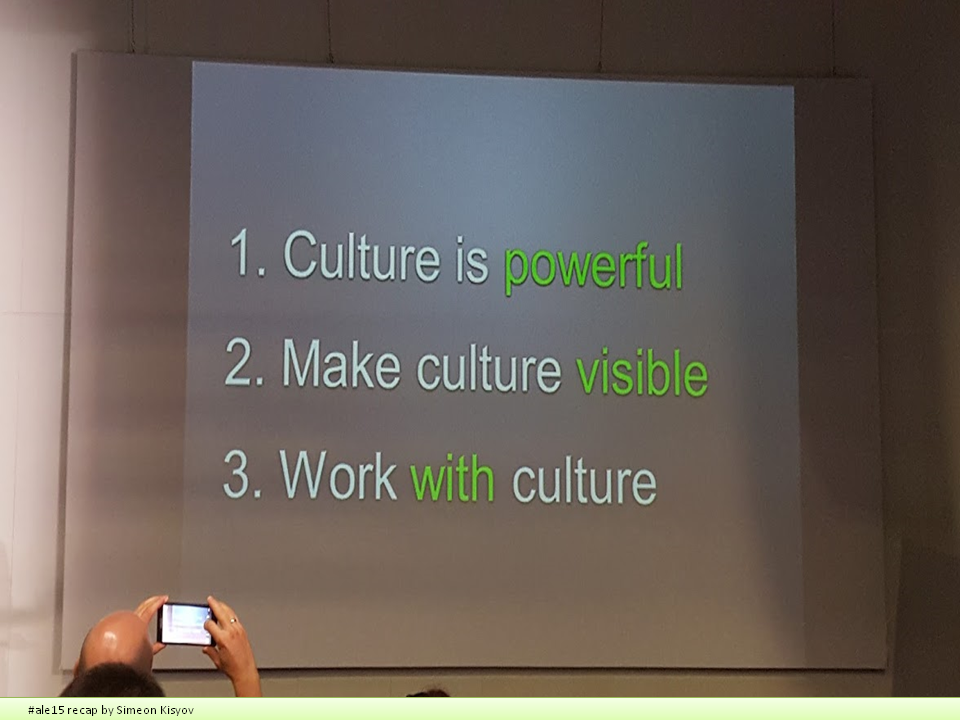
‘Your culture in the mirror’ presented by Ivana Gancheva (@IvanaGancheva).
This was the soul touching presentation (for me), probably because it tells the story of General Motors’ ‘faulty ignition switch’ and the death of more than 100 people unofficially related to the technical problem. I work with the Automotive industry and I am not with them to kill people… and none of my colleagues – all brilliant and amazing would be ok if the safety of the passengers are endangered by our products. But ‘culture eats strategy for breakfast’ and it’s a strong and difficult beast to handle.
Changing company culture is something I have always been engaged with but at the same time somehow refused to believe how fundamental it is. ‘No matter what the culture is if you inspire and lead by example – it will all be alright in the end’ I always though. But the beast is strong and underestimating it means that a leader needs to break the walls with the head. And it hurts a lot and the chance of failure is high. So we really need to start from the management and then engage everybody and persistently integrate change after change after change… I’m up to the challenge … are you?
---
Design thinking, presented by Mariana Ivanova (@olive_pro)
Had doubts whether should those slides be included in my recap. As the industry is highly regulated and we are limited on every level it is a shame the great minds working here are trapped in mundane tasks like fitting, fixing and optimising every day. Innovations and thinking-outside-of-the-box scarcity is frightening. The focus is usually on cutting costs, squeezing the maximum performance of the hardware and delivering on the lowest possible price instead of innovating the features of the future cars… yes, it is sad.
---
Bernhard Bockelbrink presented Sociocracy 3.0
A neat idea, framework or just a way to involve everybody into the decision making processes in the company. Circles are perfect - so let's use them - put everyone in your team into a circle and debate, argue and agree on every decision or policy. Then elect a team representative to sit into the representatives circle and agree on higher level. And so on and so forth. We would like to gather more knowledge, inspire creativity and increase the engagement and commitment for everybody.
---
'As a leader you are responsible for the emotional state of your people'... Boris Gloger (@borisgloger) said, and I would add that everybody should be responsible. Endorphin, Dopamine, Serotonin, Oxytocin - all known as the happy hormones. Is there an easy way to help release them in the bodies of our fellow professional soulmates? Simply saying 'thank you' and recognising the work of our teammates proves to do the job perfectly. A little hint - 'don't wait for the retrospective - make it a daily habit'.
---
For those of you who recognise my ugly handwriting - yes, it was I, engaging some brilliant minds (in one of the open sessions) into discussing 'How to engage the team into uninteresting tasks'. Really grateful for all the beautiful ideas the folks generated. The one, my evil half is particularly interested in is 'Let the team fail...' as I usually don't do this :)
---
Olaf Lewitz (@OlafLewitz) and the different stages of 'motivation'. I would proudly say - usually we are at 'We do it, because we have to' and it's not that bad. Getting to 'We do it, because we want to' and staying there would be quite challenging for any team I would say... still wanna see the sustainability (for a long period) achieved somewhere.
---
Meet Bob (not on the picture :)). He is the person (in any team) who is the one and only capable of doing specific tasks and is usually assigned first. Staff liquidity principles though, release Bob from actually doing the work - he should only train until we have 3 masters in all domains. Then Bob could go and train folks from other teams, spreading the knowledge.
---
My two cents to the conference - Uncommon SCRUM practices - follow the link or look at my previous post if you dare to challenge yourself with some forbidden practices :).
---
The blockers should be measured! (@mattphilip)
They run a project in Asynchrony only to reveal huge amount of time wasted in dependent stories. The most interesting revelation though was discovering the average delivery time in their flow is about 5-6 days instead of every 1-2 day/s (something the teams strongly believed in). The message is: 'always backup your beliefs with data and don't just rely on your gut feeling'. Matt's slides are all shared on slideshare.
---
... and some basics on 'how to influence better teams'
---
(@rachelcdavies) on some cool ideas about 'building learning into teams'.
Coding dojos, pair development - and more than two devs, lightning talks, swapping teams, and even knowledge tokens. All great practices to share the knowledge in and out of your organisaton/team.
---
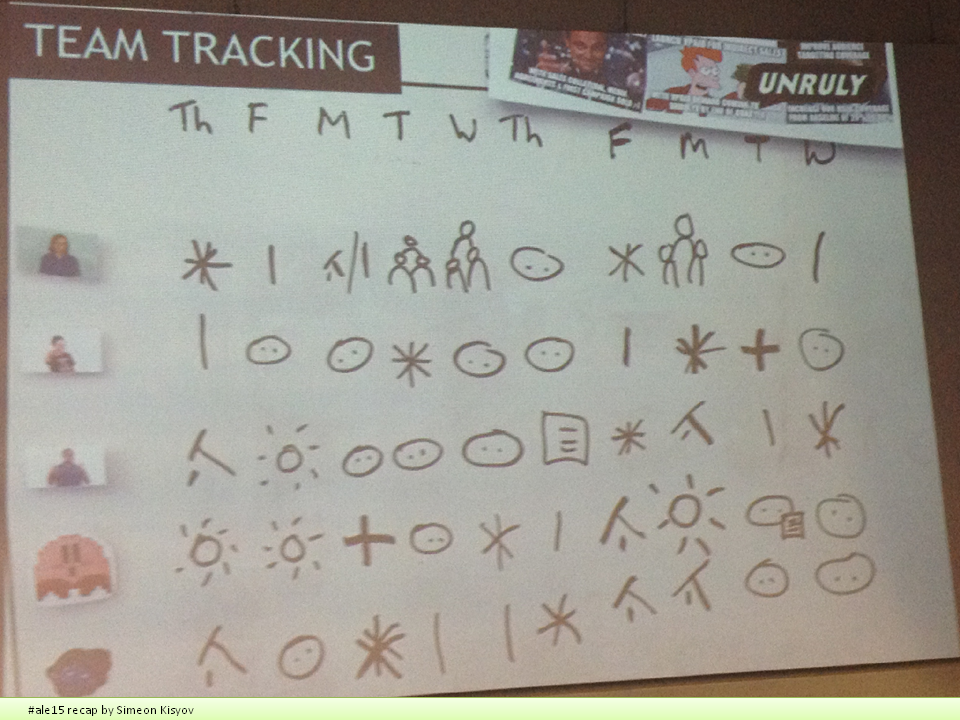
And finally - this is how they visualise the daily time spent into a team in Unruly. Looks cool.
---
The entire presentation on slideshare (the questions are to challenge the colleagues to provide back some thoughts and feedback):
Thursday, 21 May 2015
Scrum in real life
Lately I’ve been asked to explain Scrum in less than 5 mins to regular folks, without framework terms.
Here is how I did it
- Have a long term vision or goal of what do you want to achieve (e.g. get fit and improve your health)
- Create a to do list with actions producing results, contributing to the main goal (e.g. run every day for 10 mins, go to gym 3 times a week, sell the car and walk more)
- Have somebody (could be you) prioritise your list – focus on short-term benefits
- Set a timebox to challenge yourself with some of the actions (e.g. day, week, two weeks)
- Commit to actions you assume can do in the timebox
- Check how you are doing every day for a couple of minutes
- In the end of the timebox summarise and celebrate your successful actions
- Review and prepare the actions for the next timebox
- Repeat
Sounds simple? Then why you can’t find many folks doing this naturally?
Some of the reasons
- People usually aim big. This is the worst mistake. Nobody wants to chase 100$ tomorrow but almost everybody will chase 1 000 000$ for many years
- Folks get easily demotivated just doing small stuff. Celebrate and value every success – no matter how small it is
- It is difficult to prioritise. Even more if you are just long-term thinker
- Focus loss or vision change
- Iterations are not comfortable… in fact they are usually stressful
- Folks not comfortable taking full responsibility and leading (even their own life/business)
- People not comfortable with all the transparency of their progress (sometimes it’s simply not looking good)
Friday, 5 October 2012
Eleven rules of life (for kids and students)
A story about Bill Gates given speech in front of little students and presented golden rules of life circulates the Web for a long time. The truth actually is that Bill Gates has never given speech for those school students, neither he has written the life rules. Nevertheless, the rules are really good and I would like to express my thoughts on them.
Let’s go:
1. ”Life is not fair - get used to it!”
- I love this one. This statement saddens and brings joy at the same time. If life was fair – you would have a fixed place in it and no other possibilities at all. Your skills and potential would be measured and then you will just get what you deserve. Instead, life is not fair and the possibilities are limitless. You could fall very hard or fly very high – it’s really up to you.
2. ”The world won't care about your self-esteem. The world will expect you to accomplish something BEFORE you feel good about yourself.”
- “To accomplish” is definitely the lead motivator in life.
3. ”You will NOT make $60,000 a year right out of high school. You won't be a vice president with a car phone until you earn both.”
- Life is all about the journey. We need goals set high enough to keep the journey going as long as possible... or actually forever.
4. ”If you think your teacher is tough, wait till you get a boss.”
- Very nice one... Remember – ”life is not fair”. Sometimes you will have a boss less capable, intelligent and resourceful compared to yourself... but you still need to keep going and do your best.
5. ”Flipping burgers is not beneath your dignity. Your grandparents had a different word for burger flipping: they called it opportunity.”
- Every job/task is an experience and brings possibilities to refine your skills.
6. ”If you mess up, it's not your parents' fault; so don't whine about your mistakes, learn from them.”
- And you will mess up a lot. So get used to it. Learn from mistakes and improve yourself... and learn to enjoy the ride.
7. ”Before you were born, your parents weren't as boring as they are now. They got that way from paying your bills, cleaning your clothes and listening to you talk about how cool you thought you were. So before you save the rain forest from the parasites of your parent's generation, try delousing the closet in your own room.”
- Respect your parents. Their life wasn't easier than yours is. Still they managed to help you and invested a lot in you. If you have parents who love you and care about you - you are so lucky.
8. ”Your school may have done away with winners and losers, but life HAS NOT. In some schools, they have abolished failing grades and they'll give you as MANY TIMES as you want to get the right answer. This doesn't bear the slightest resemblance to ANYTHING in real life.”
- Another great one. In real life you pay the price for your mistakes (and even for your accomplishments). And sometimes the price is very high. So be careful, think and plan and then be brave enough to take risks.
9. ”Life is not divided into semesters. You don't get summers off and very few employers are interested in helping you "FIND YOURSELF". Do that on your own time.”
- Be very well organized. It is probably the best skill you could acquire in life.
10. ”Television and video games are NOT real life. In real life people actually have to leave the coffee shop and go to jobs.”
- Real life is full of things you are not going to like at all. There are two possible ways to approach these. Look at them as challenges and opportunities to prove yourself or just give up and go in a different direction. I would definitely recommend going with the first choice... it builds up your character.
11. ”Be nice to nerds. Chances are you'll end up working for one.”
- Every person has strengths and weaknesses, so respect people. You could learn some good lessons from your nerd-boss and use them to your advantage.
Wednesday, 15 August 2012
Slivers of Time systems
Imagine the following scenario: Larry lives in Liverpool and he has old mother (living in the London area) who requires some help with her groceries ever Monday and Thursday and would enjoy a social visit every Saturday late afternoon. Now imagine that you live in the same area as Larry’s mother, have spare time and are willing to befriend and help the old lady. But how could you know who would need your help… and when? Well... 'Slivers of Time system' knows.
Slivers of Time is a software platform that allows workers and volunteers to set up their availability by selecting number of hours at a specific date/time they are willing to work/volunteer. The system also allows companies/agencies/recipients to book the workers or the volunteers for their specific needs at the specific time.
It is all about a market – where you could set that you are available for example - every Sunday from 7pm to 9pm. You could also set if you are willing to give your time for free (as volunteer) or want to sell it. Then the person or the organization that needs you only has to book your time. You are going to receive confirmation sms/email message and you have to confirm and agree with the booking. And it is all set – just in a matter of seconds.
It might be arguable if the future belongs to the flexible labor market but it is certain that there will be higher demand for flexible work time workers and volunteers in the next few years. Also, self management systems will have tremendous impact on cutting costs and time of organizations and labor force management.
The current Slivers of Time platform includes a lot of features. It allows:
- Registration of volunteers/workers.
- Registration of recipients and agencies.
- Assignment of different agreements/contracts to different volunteers and recipients.
- Volunteers/Workers/Recipients management by the agencies administrators.
- Booking of hours either for money or for free (volunteering).
- Creation of timesheets for all bookings.
- Generation of different kind of reports, including: bookings, volunteers, recipients, timesheets, etc…
- Customization of the system and the whole experience, depending on the agency that is about to use it.
Currently the system is only available to agencies and not widely released to the public. This is a real disadvantage and if you wish to register and participate as either recipient or volunteer/worker you need to find an agency in your area that is using the system and register using their web site. But still there is a great potential in the platform and it helps a lot of people find needed help/services in the needed time. Another great feature is that a person could be booked for a specific job by a third party (on behalf of recipient for example) too. This way Larry (from our story at the top) could really book somebody to help his mother by providing her address and contact details. Then his mother could assess the volunteer and the service she received and this assessment is visible on the volunteer’s profile.
Wednesday, 6 June 2012
Some great adverts
Looking at some very creative and great adverts and thinking about what makes a great commercial… great. Well, first it needs to tell a story. But not just any kind of story – the story should have unexpected and unusual ending. Second, the atmosphere should be unique – it needs to suck the visitor inside the advert reality. Third… and you know this – it is all about emotions, so the advert should provoke a bit of a drama and/or fun and a lot feelings, while watching it. And never forget the formula:
useful + entertaining = valuable
In the particular case of creating valuable advert the entertaining part prevails but the result could really be outstanding. Enjoy some great adverts and feel free to add your favorite ones in the comments below too.
useful + entertaining = valuable
In the particular case of creating valuable advert the entertaining part prevails but the result could really be outstanding. Enjoy some great adverts and feel free to add your favorite ones in the comments below too.
Thursday, 31 May 2012
Why Facebook is so successful?
We all know about how Facebook turned into the most significant online tycoon in the past few years. But did you think about what kind of innovations and value it brought to become the most successful web portal. Well, I did and let me share my reflections with you.
What is actually Facebook?
It really is a mix between dating portal + blog/tweet/forum platform + contact list/messaging platform. And Facebook just took the most valuable and simple functionalities from the other services. You easily search for people and add them to your contacts/friends list (like in a regular dating/contact list web site). You could post a note or article, message a friend, or even upload pictures and videos in a very friendly manner too. The Facebook maximized all the aspects of good web platform using the formula:useful + entertaining = valuable
Facebook innovations
- Facebook Wall.
The user’s wall is the heart of the Facebook platform. It is simple to post something there, and it is immediately shared into one “huge wall feed” where everybody could keep track of what the other contacts are doing. The wall is very easy to use – clean of any “advanced features” like text editor or smiles – yet it adds a great value to every Facebook user. The three actions allowed for every post are also selected very carefully. Everybody could just: like, share (repin on his/hers wall) and comment the posts. It is simple and effective.- The applications development.
Facebook did something never seen before. It allowed companies to develop their own applications and run them in Facebook environment. It also provides user information to be used by these applications and thus the social games were born, for example. Facebook uses a shared revenue model for all applications and combines it well with the advertisement business model.- The “like” widget.
Facebook introduced a very small and easy to use piece of code that most of the webmasters incorporated on their websites. The visitors could just “like and share” every article/item on Facebook and thus create content for Facebook, while in the same time bring additional traffic to the websites. This way Facebook serves as a story sharing website similar to Digg for example.Comparing Facebook to Forums
Before Facebook, the largest social online Medias were the forums. Well, the forums are still a great source of specific and detailed information but they could never reach the critical mass of users, Facebook accumulated. Some would argue that Facebook is full of just crappy content and that’s 90% true but also it is true that most people prefer to stay on Facebook than spend time on their favorite forums. The thing is that it is really time consuming to post a well written article on a forum, and in order to build reputation and to be respected there, a person really needs to be a great expert in particular forum topic and also be very dedicated to share the knowledge. Most people do not have the time, neither the expertise to participate actively on the forums. Well, they certainly have the time to post quick quotes on their Facebook wall, message a friend, upload pictures, comment over somebody else’s posts, play a game or simply look around what their friends are doing on Facebook.Comparing Facebook to Blogs
Several years ago the blogs were the real trend. Everybody was talking about blogging, commenting and social Medias… And Facebook successfully killed a great portion of the blogs out there. The Facebook wall is actually a micro-blogging platform – easier to use and set up, compared to every blogging platform. And again, some might argue that blog content is more valuable and professional but a regular user also needs more time to read a huge well written blog post compared to a simple Facebook post.Comparing Facebook to traditional Media
It is hard to compare Facebook to traditional online Media, because of the cost of the content. The cost of the content on Facebook is basically free, while the cost of the online media’s content is expensive as they need to pay journalists, editors, photographers, etc… And again the credibility and the value of the content are on a completely different level compared to Facebook. Also, specific media channels attract specific kind of audience that would not be involved in using Facebook a lot, like business people, financial persons, managers, etc…So, what is going on Facebook?
It really seems the users are looking for 3 major values in a modern social media. The social media should be easy to use, not time consuming to post and definitely not time consuming to browse, regarding particular item. Twitter complies with the same basic principals. We all live in a time where we want things to be fast and easy. And again, Facebook might seem shallow but many people definitely love it and are addicted to using it.
Subscribe to:
Posts (Atom)